
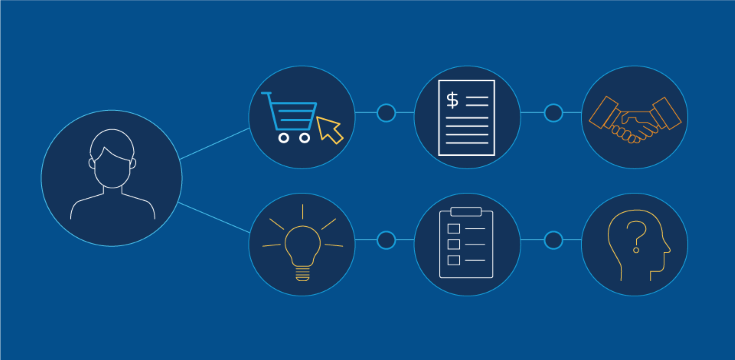
A Customer Journey Starts With Your Customer
One of the key reasons is that businesses have not reviewed and updated their service models in line with the changed customer behaviour and needs in the post-pandemic service model. The bottom line is that customer behaviour has changed. In some industries the changes have been profound and expectations are radically heightened.
Many businesses had to rapidly escalate their migration to the digital realm and did not have the luxury of pre-testing their value offerings with customers during this phase. Forced into e-commerce by a pandemic and unexpected lockdowns, many companies had to evolve through trial and error.
Reviewing or creating your customer journey starts with your customer, not your business processes!
As so much changed for consumers globally since the start of the pandemic, it is more crucial than ever to understand what has changed for your customers, and why and how. In this process of either reviewing or crafting a customer’s journey, the starting point should always be with the customer and not your internal business processes.

Opinion by Liezel Jonkheid, Director of the Consumer Psychology Lab
Has their purchase behaviour changed, are customers using different channels, are they complaining more, and if so, what are their pain points? Where are they directing their complaints to, are they returning more items than usual, and so on? Answering these questions will be important for your customer journey mapping process.
Understanding your customer – what they need, struggle with, expect, how they go about it. What influences their decisions, is challenging and never a static or once-off process. Especially at a time when consumers themselves have been exposed to a radical, shape-shifting change in the last two years.
Getting a good handle on the shifting sands and how they are likely to evolve is a dynamic and challenging process. It vital to the business sustainability going forward.
Methods to get a clearer view of how to direct the mapping of the current, or future customer journey
Ask your staff
One of the most overlooked yet richest sources of customer insights is your customer-facing staff. Whether on the floor or in the call centre, they see, hear and experience your customers’ actions and behaviour directly. They know what customers struggle with, and they know how they struggle to serve customers with problems. Especially if they do not have the resources at their disposal or are not empowered to do so.
Create opportunities for open discussion sessions about what the staff observes and ask for suggestions to address customers’ challenges. Another way to learn more about customers, and interact with customer-facing staff, is to be on the floor. Walking about and observing the interaction, especially at the customer service desk, can present valuable insights into how customers behave.
Staff surveys can reveal additional information about the service delivery challenges and customer behaviour. Keep the survey anonymous and focused on what they perceive to be the biggest challenges for customers, and what stands in the way of delivering the desired experience.
Ask your customers
Customers provide unsolicited feedback on what they struggle with through a variety of channels. For real insights, take a deep dive into and review the type and frequency of complaints and queries. Have a look at the cost to serve and any lost business. Escalated issues to the management level will provide a clear indication of which issues or processes are fuelling the frustration or anger of customers.
Informally talking to customers on the floor may be one of the easiest ways to get information about what customers want, need, and expect, and one of the most honest reflections of where your customers find themselves.
Social media is also often used by customers who feel they are not heard and have not had satisfactory support on their queries. Your social media channels are a rich source of insights about what creates discontent, as well as customer satisfaction where there is a rave of reviews.
Customer design groups are one of the most effective customer journey design approaches as they include your customers in the design process. Using a similar approach to focus groups, customers are invited to collaborate in the design, facilitated by experienced CX specialists, providing the optimal outside-in perspective directly from your customer in the journey design.
Be your customer
Stepping into the shoes of a customer is a simple and effective way to assess your customer’s experience when interacting with the company – think the “undercover boss” reality show where CEOs went undercover to get a first-hand experience of the service experienced by customers and provided by employees. This is a highly effective way to put proclaimed service delivery to the test and an employee can easily be tasked to become a customer for a day and to record their experience.
Mystery shopping
It is said that the highest-paid staff, are generally the furthest away from the customer. This has been highlighted in studies by Harvard Business Review (Bains & company) where the findings indicated a massive gap between what the leadership believed to be the satisfaction levels of customers (80%) versus customers’ actual reported satisfaction level (8%).
- Ease – how much effort was required to perform the task,
- Success – to resolve challenges,
- Emotion – what emotions were experienced, and
- The company’s customer promises or corporate values may also be used as criteria to identify gaps, inconsistencies, service failures, and best practices.
Making sense of different data sources
Many companies do not have an internal CX specialist to collate and interpret all the sources of customer insight. This is where a professional CX specialist will prove invaluable in being able to cluster the needs, expectations, pain points, satisfaction, gaps, and so on related to the steps in the customer journey.
This data provides valuable insights into what customers experience, where things go wrong, how they communicate their challenges, how it was resolved, what their responses were, and the overall impact of their experience on the trust and loyalty they have in your product and brand. Bringing these clusters of insights into the customer journey design workshop helps the collaborators to keep the focus on the customer.
The only way to achieve this is to involve your customers in the design process or bring real customer insights into the design workshop. Customers are humans, and humans are never consistent. People are affected by internal and external forces and changing landscapes – and this has been dramatically evidenced in the last two years of the pandemic experience and how this has reshaped consumer behaviour.